|
Topic 3 - Taking the Loan Application (Link to CVS HOME PAGE) (Download Printable Version Here) To benefit the most from this section, we suggest that you print out a hard-copy of the "Uniform Residential Loan Application" for reference during the tutorial. You will need a .PDF (Adobe Acrobat) program to open this file: Click here to open and print the "Uniform Residential Loan Application": Since our final destination is homeownership, the road map we'll use is the "Uniform Residential Loan Application" (URLA), more commonly referred to as the "loan app" or 1003 (ten-o-three). When filled out accurately and completely, the 1003 will tell you where to turn, when to stop, and how to avoid potential delays and obstacles along the way for a smooth and speedy trip. At the end of this chapter you should be able to: · Complete the ten sections of the Uniform Residential Loan Application (1003). The purpose of the 1003 is to help you paint a picture of the borrowers' qualifications through the collection of information, so the lender/investor can make an informed decision as to whether or not they should lend money (lots of money) to the applicant's). A 1003 that is complete and accurate will help you better serve the borrowers and other parties involved in the process. The borrower's needs, such as the type and size of the mortgage, down payment, interest rate, and the most efficient way to process the mortgage will be identified through the 1003. Remember, the borrowers are anxiously awaiting an answer on their mortgage application. Take the time to get it right the first time. Asking for information that could have been obtained initially, is often upsetting to the borrowers and reflects poorly on you and should be avoided. This thoroughness will build your value and professionalism in the eyes of your customers, co-workers and other industry professionals who interact with you. Gathering complete and accurate information along the way, will get you to your destination more quickly and comfortably than trying to take back-roads and shortcuts to homeownership - so no guesswork and no shortcuts. The only exceptions allowed are those internal processes unique to your organization and your investors, if any. Since you will be gathering information from your borrowers, they will need to be prepared to provide that information to you. Sounds pretty obvious, but it may not be so obvious to your borrowers. To help streamline the process, you may want to prepare a checklist of some preliminary information before you start. Over the next few pages we will take you on a step-by-step tour, pointing out typical documentation you will need to gather. Again the exact level of detail required to complete the 1003 is determined by your internal processes. For example, if you are using and automated underwriting (AU) system, you’ll want to know what minimum 1003 data entry requirements are in order to receive complete and accurate feedback. The feedback report from the AU system will be your guide for gathering the loan documents. However, regardless of the system and processes you follow – understanding each section of the 1003 and the importance it plays in documenting and processing the loan is key to successfully closing the loan. In all there are ten sections of the 1003 with extra pages when needed for extra information: I Type of Mortgage and Terms of Loan II Property Information and Purpose of Loan III Borrower Information IV Employment Information V Monthly Income and Combined Housing Expense Information VI Assets and Liabilities VII Details of Transaction VIII Declarations IX Acknowledgement and Agreement X Information for Government Monitoring Purposes and "Continuation Page(s)" if necessary. Section I. Type of Mortgage and Terms of Loan The first stop in filling out the 1003 is Section I, which you’ve got to admit is a great place to start. Here you will spell out details about the type of mortgage being applied for and the terms of the loan. The loan will also be assigned a case number so that it can be tracked as it begins the journey through the loan process. |
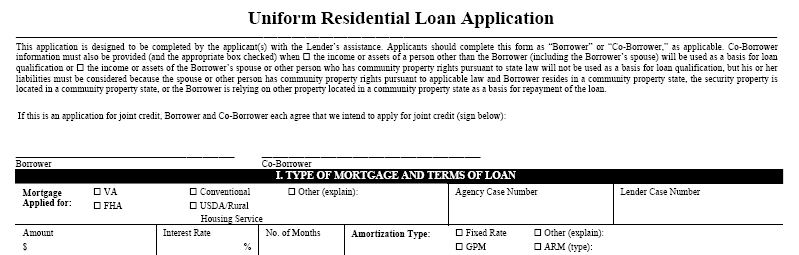
This is how the section looks on paper:
|
Notice the small print at the top of the first page of the 1003 below the "Uniform Residential Loan Application" heading. This is the area where the borrower or borrower's declare if they are pursuing financing with the resources of another party such as a spouse or non-spouse co-borrower. Check the first box if the income or assets of a person other than the borrower will be considered and the second box if the income or assets of a borrower's spouse will NOT be considered. After this declaration is attested to, the borrower (s) must attest to this specific point before proceeding. This is an important issue to confirm because the majority of loan fraud happens on the actual loan application. If a borrower is married and declares to be unmarried or another non-disclosed party who has community property rights to the subject property isn't referred to, it's blatant fraud. Married borrowers must have a waiver or similar subordination to the non-borrowing spouse of community property rights to the lender. If a borrower is married and borrowing alone, they must disclose it and you as a mortgage professional are as responsible for this, perhaps MORE than the borrower. The next area asks the borrower what type of "Mortgage Applied for:". Is it a "VA, FHA or Conventional insured mortgage, USDA/Rural Housing or other" type? (perhaps sub-prime or special municipal/state sponsored program) of home loan? Make sure you choose at least one because the next person who views the application will be clueless on how to process the file for approval. As you'll continue to see, much of the efficiency in processing and end-all success or failure of the loan depends on the completeness of the loan application. Remember - The more information the better, so fill it up with dependable borrower data or you'll sink the deal! The area under "Agency Case Number" is usually relevant when the loan is government-insured. Both VA and FHA issue case numbers when the loan is registered online for government insurance processing. This is also the case with FMHA (a.k.a Farmers Housing Administration - Rural Housing) mortgages. You probably wont have this information at application but a processor will have to add the case number on the amended 1003 for underwriting submission. "Lender Case Number" refers to a special loan number your company may assign the loan internally. Most retail mortgage bankers and/or larger retail origination shops make assigning this number a priority for tracking loan production and time spent in processing. This will become more clear when you start using your loan processing software like Calyx, Encompass or other. The "Amount" section is pretty obvious. It's the loan amount the borrower is seeking. You may be taking this application for pre-approval and not sure what the final loan amount will be, but you MUST PUT SOME LOAN AMOUNT IN THIS SPACE at application. Why is this? Because key RESPA disclosures should be generated within 3 days of your receipt of this loan application. These disclosures cannot be generated without tentative numbers such as loan amount, interest rate, loan type, loan term and other. Again, one little space left blank on the initial application can mess everything up. Counsel your borrowers that they must apply for some approval scenario whether they know they will get approved for it or not. You can always reduce the loan amount, payment and interest rate later but going up on these estimates later will create another embarrassing glitch. The "Interest Rate" section is similar to the loan amount section in that it must be estimated at some percentage to trigger the rest of the mortgage process. This is a pretty sensitive area because today's borrower really tends to interest rate-shop hard. If you estimate the rate too high, they may think you don't want to compete and back away from applying with you. Estimate too low, and all the numbers will be higher later including the payment (Ouch!). This makes you appear to be a liar and/or "bait and switch" artist which will ruin your reputation and perhaps lead to litigation that the borrower will probably, win because the laws are designed to protect them more than you. My suggestion stands the same here, guess low (set lower expectations of what can be attained) and prepare your borrower that you will always shoot for the best rate first, but you'd rather prepare them for the worse case scenario if their qualifications are at all questionable. Special Note: In the end, the borrower has the right to apply for any loan they want but the hope is that you can advise them with balanced and realistic expectations of terms based on solely, on their credit, capacity and collateral qualifications. The "No. of Months" section refers to the amortization term the borrower would prefer. Most of the time you will fill this area in with "360" (30 Years) but when rates are low or if the borrower has a lot of equity in the subject property, the smart borrower may work towards a shorter term amortization. 15, 20, 25 year amortizations usually have lower rates and build equity fast. Obviously, a shorter term means higher payments but this is because of the extra principal being accrued in contrast to the 360 and not the result of increased interest as with sub-prime loans. "Amortization Type" refers to the type of mortgage program the borrower would prefer. Most borrowers want a fixed rate for the certainty of an unchanging principal and interest payment but when rates are curbing higher or the borrower is most likely to qualify for a sub-prime loan, an ARM (Adjustable Rate Mortgage) is often preferred. Again, this area must be filled out completely to properly merge data into the Truth-In-Lending disclosure for Reg Z due to the borrower at application or within 3 business days of your receipt of a signed application. Just so you know, "GPM" stands for Graduate Payment Mortgage a loan payment term usually offered by the FMHA that is adjusted to the borrower's income. Many originators mark the "Fixed Rate" box for mortgages that have balloon payments but I would suggest you mark the "Other" space and write in the type of balloon such as, a 7 or 5 year balloon. Always err on the side of borrower protection by disclosing what loan term might appear riskier to the borrower and you will be known as an honest and trusted advisor whether the borrower understands your standards of decency at the initial meeting or not. As we continue with the sections you might wonder how you can know what probable terms the borrower may qualify for. This online class is a start but this "street-underwriting" talent evolves from studying your lender matrices for each specific program. If you need help with getting these, contact a wholesale account executive or email me at: admin@caryvalentine.com for some samples. I will also help you individually, with understanding wholesale interest rate systems of pricing. |
Section II. Property Information and Purpose of Loan
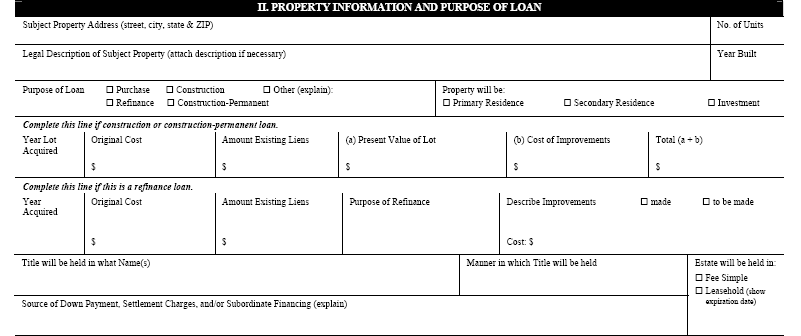
This is how the section looks on paper:
|
"Subject Property Address" is pretty obvious but often left blank by originators. This is not referring to the borrower's current address necessarily, but the subject property proposed for financing. If it was a refinance of their current residence then it would be the same. In a pre-approval scenario, most underwriters suggest writing "pre-approval" or "to be determined" in this area. "No. of Units" is question about if the property is a single family, duplex, tri-plex or four-plex property. The conforming secondary doesn't tend to consider anything past an original use (how it was originally built) four-family dwelling as residential which is what the 1003 form is normally, to be used for. You might not be able to list the "Legal Description of Subject Property" until you get the title work or appraisal which usually comes after processing is started. Do your best here but not having it at application doesn't tend to clog up the process at the start. "Year Built" is the year the subject property was originally constructed. "Purpose of the Loan" refers to the purpose of the transaction. A purchase demands certain documents for processing that a refinance may not. A construction loan request extends the processing time and may change requirements for "Adverse Action" (Adverse Action is compliance issue dictating a certain time the borrower must have an approval, denial or counter-offer documented from the lender within a reasonable period - 30 days is normal). "Property will be:" is a biggie! If the borrower or yourself fails to answer their occupancy intention truthfully, this is outright mortgage fraud. The borrower's subject property occupancy status is a significant factor to the calculation of risk. Its a statistical certainty that non-occupant or "Investment" borrowers are far more likely to default on a non-owner occupied than a property used as a "Primary Residence" or "Secondary Residence" which refers to a vacation home. Special Note: An RV used as a secondary residence tax deduction is not a financable secondary residence in the mainstream, mortgage market. Just remember, if it has wheels under it, you can't finance it in the secondary mortgage market. "Complete this line if construction or construction-to-permanent loan" is applicable when a borrower is seeking to build a home but needs to qualify for the permanent mortgage loan's terms first. This is often necessary because construction loans are short-term loans that are normally, provided by banks direct to the consumer or through some wholesalers for retail brokers to offer. "Construction loans" are normally, the product of depositor's funds which are better oriented for short term lending. Construction-to permanent loans refer to one-stop transactions where the construction and permanent mortgage are closed at the same time. Continue to answer the rest of the questions on this line such as "Year Lot Required", "Original Cost", "Amount of Existing Liens", "(a) Present Value of Lot", "(b) Cost of Improvements and "Total of A+B", about the newly or proposed constructed property as accurately as possible remembering that budget overruns are common in new home construction transactions. You and the borrower's biggest fear should be that the final cost of constructing the subject property may exceed the final value of the completed home. Institutions who make these consumer-direct construction loans tend to pad their loan-to-values to avoid such a loan-to-value deficit and you are best to advise your borrower about those 'cost-extras' they may want to limit when building the home. Note the section now entitled, "Complete this line if this a refinance loan". Refinances have special factors associated with length of ownership and whether property equity is being cashed out or not. "Year Acquired" is important because Fannie and Freddie often stipulate a seasoning period on property ownership necessary for 'cash-out transactions' and some 'rate & term transactions' as well. This 'cash-out' issue is also effected by what the "Original Cost" of the subject property was and if it's current value is more or less than the original cost. The "Amount of Existing Liens" is important because we must know the current principal balance against the subject property to determine what we need to payoff and/or what we can cash-out after existing liens are settled. "Purpose of Refinance" refers to if the borrower is seeking cash-out or just refinancing their current mortgage seeking better interest terms. Due to the heated controversy associated with anti-predatory lending initiatives, you may find that underwriters are more concerned that the refinance you are proposing is going to truly benefit the borrower. Is your borrower getting a better interest rate, consolidating debt or making improvements etc...? If not, the underwriter may require you to make a case that the loan isn't just a way for you to make a loan commission. This is what the phrase "predatory lending" actually refers to. "Describe Improvements -Made, To Be Made" may be applicable if the value of the subject property has drastically improved since the purchase date or if the loan is being sought to make improvements. Most emphasis is placed on this number in 'cash-out' mortgage scenarios or when a borrower is seeking to eliminate a mortgage insurance charge. "Title will be held in what Name(s)" is simple. What is the full names of the individuals who will be named on the property's deed. Don't forget that non-applicant spouses still have a rightful interest in the property in most cases. This must be declared here whether they live in the property, pay for it or not. "Manner in which Title will be held" is ironically, just that; the manner in which title will be held. Have you ever heard legal terms of ownership expressed as joint tenants, tenancy by entirety, sole person etc...? Depending on the state and/or county the subject property is in, you will have to identify the manner in which title will be held. It's usually listed on the title commitment and as processing proceeds, you will find this out but you should know your local jurisdiction's property ownership definitions. "Source of Down Payment, Settlement Charges, and/or Subordinate Financing (explain)" is a crucial issue in qualifying as you will find out when studying "Section VI". Source of funds for closing in the age of "dirty money" carries significant implications of fraud and/or loan risk. The so-called 'money in a mattress' or 'stray cash' argument falls on deaf ears in the secondary market as you will soon learn. Special Note: Subordinate financing here refers to a second mortgage used to complete the purchase of the subject property. A popular program offered by lenders today is to simultaneously, offer a first mortgage for 80% of the sales price and the remaining 20% needed comes from a second mortgage. This arrangement allows the borrower to borrow without the cost of mortgage insurance. The total payment of the first and second mortgage is often less than a first mortgage at a higher loan to value with mortgage insurance included in the payment. "Estate will be held in:" refers to how the lot is owned. "Fee Simple" is the most common land right denoting that the house and land is wholly owned. This type of estate can be willed or disposed with unrestricted powers. This is in contrast to a "Leasehold", a lot ownership right that refers to a house placed on a property that is leased. This type of estate-hold is common in high land-cost areas like Hawaii. The traditional requirement has been for the lease to exceed the term of the mortgage by at least, 5 years but verify this with your underwriter as some conforming lenders have avoided leasehold arrangements altogether by company policy. Section III. Borrower Information This is how the section looks on paper:
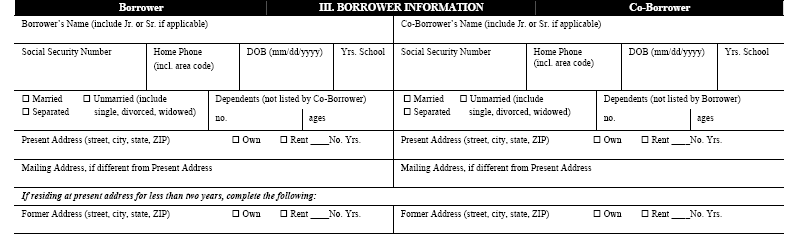
"Borrower's or Co-Borrower's Name" is easy enough to figure out. Make sure you note if the borrower is a junior or senior because credit reports still often merge a father's credit with a son by accident and vice a versa. This doesn't happen as often on female credit inquiries but it is still an issue usually, as a result of mother/daughter having the same middle names. Still, a middle initial is always recommended to help verify that a credit report trade line attributed to your borrower is actually theirs. Special Note: Don't necessarily assume that a male is always to be listed as the "Borrower". This assumption is often interpreted as 'gender bias' which needs to be avoided. The truth is that both borrower's are on the hook for the same amount of promissory liability regardless of how their listed here so who cares who comes first? The "Social Security Number" area content is not to hard to figure out but the biggest issue I can warn you about here is to get the number exactly right. If you miss a digit here, it could spur an identity theft concern and a great deal of red tape. A bigger issue is that you will have to eventually prove that the Social Security Number is valid for the listed borrower or you will be the first one accused of fraud. Special Note: Make sure to check out the resource entitled 'Identity Theft Hurts Everybody'. "Home Phone" - If they don't have a home phone make sure you obtain a cell phone or some other personal contact number but a borrower does not have to have a current home phone to get a mortgage loan. "DOB" or "date of birth" should be listed in the format asked for of "mm/dd/yyyy" or another identity fraud alert is possible. Leaving this area blank often leads to false trade lines showing up on the credit report for your borrower. Most credit reporting portals will make you list the complete date-of-birth as well, so make sure you get it correct. "Yrs. School" - This section is less about equating loan qualifying with years of secondary education and more about HMDA reporting concerns. It usually becomes an issue if a borrower has been at their current profession for less than 2 years and wants to claim that they were in school to avoid an employment guideline 'capacity' deficit. Most secondary lenders seek 2 years of uninterrupted employment/income for premium loan terms. Under "Married - Unmarried - Separated" you must make sure the borrower's marital status is clearly stated. Pressure them for confirmation of this and if they have child support or alimony payments as a result of a prior marriage, relationship or separation agreement. If they owe or receive child support or are required to pay alimony, it's pretty necessary that you know about it at the beginning. "Dependents (not listed by Co-borrower)" is often relevant because many families are now merged as a result of multiple marriages and/or prior relationships. Don't' forget that just because a dependent does not live in the same home with the borrower/co-borrower does not mean that they are not a dependent of the borrower/co-borrower. "Present Address - Mailing Address - Former Address" should always have at least one residence listing. As the section states, you must document the last 2 years of residence history. The 1003 also comes with a "Continuation Page" if you need more room for multiple addresses. Section IV. Employment Information This is how the section looks on paper:
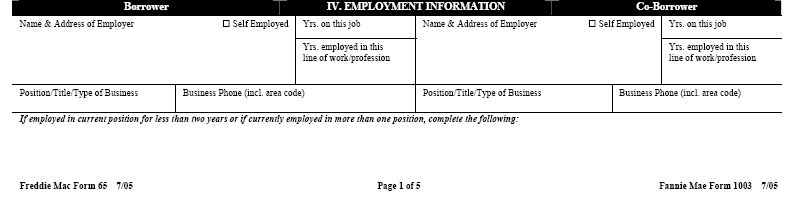
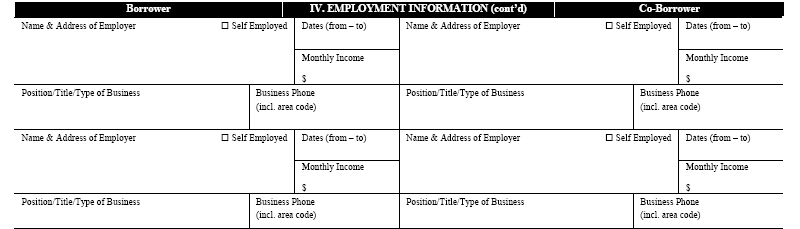
The section is continued on page 2 of the 1003:
The "Employment Information" section is a very key processing data-gathering tool. Generally, borrowers must be prepared to document 2 years of employment history to establish income stability for loan approval. If W2's, pay stubs and/or tax returns are inconclusive, the processor must prepare a document known as a "Verification of Employment" (click name to view). "Name & Address of Employer" must be filled out completely. The suggested address is a street number in lieu of a P.O. Box. If the borrower/co-borrower has been at their job for less than 2 years, the processor must have a good address to request a Verification of Employment or the loan will be suspended until this issue can be documented according to underwriting standards. Note that "Self Employed" must be marked if the borrower is using self-employed income to qualify. Generally, a borrower who owns at least 25% of an entity should supply complete tax returns for qualifying. Self-employed borrowers have special needs in the secondary mortgage market which I will be glad to memo each of you individually about by email at: admin@caryvalentine.com. If the borrower works 2 jobs currently, the recommendation is to list the second job in the next "Name & Address Employer" area that is open. Remember to use the "Continuation Page" if you run out of space here. You may also notice that the employment data areas on the second page have a "Monthly Income" blank. This usually refers to prior or supplemental income to the primary employment income numbers listed on the following page. This is kind of redundant since the coming section requires an itemization of income. Despite these seemingly, repetitive requests for income totals, each instance of perceived redundancy has a specific purpose towards documenting income stability. Under "Position/Title/Type of Business" you should seek to extract if the borrower is salaried and/or in a commission pay status. The next section refers to this specifically but if a borrower states "Sales", "President", "Owner" etc... here, their is a good chance you will need to process them as or in similar fashion to a self employed borrower. Note that "Business Phone (incl. area code)" is vital because most underwriters will direct that the employer be contacted verbally, just prior to closing as a quality-control step. Make sure the number is good or problems will arise for the processor and quality-control investigator. Section V. Monthly Income and Combined Housing Expense Information This is how the section looks on paper:
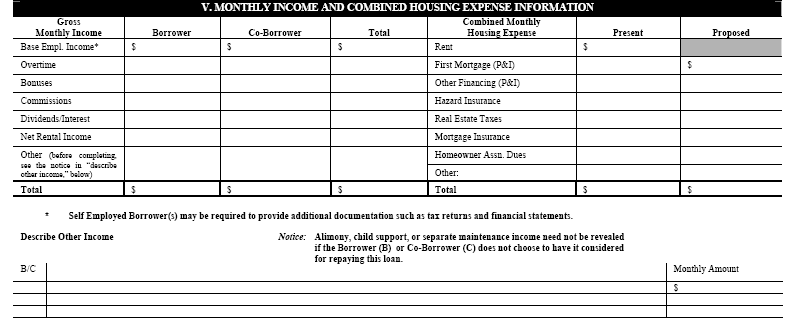
|
|
This is the section where we breakdown the borrower's income. The importance of extracting the type of "Gross Monthly Income" is due to the various ways certain types of income streams are viewed in the secondary market. Generally, "Base Empl. Income" refers to a salaried borrower with stable and consistent income. "Overtime" is applicable when it is (duh!), and "Bonuses" are often the source for down payment or if consistent over a period of at least 2 years, they can be an income qualifying attribute. "Commissions" again flag the need to gather tax returns as well as "Dividends/Interest" and "Net Rental Income". "Other" makes reference to the figure disclosed in the area at the bottom of the section under "Monthly Amount". A history of consistent income over the last 2 years with likelihood of continuance is always the standard for alternative income sources including and in addition to "Base Empl. Income". Refer to the top right page of the page to the heading "Combined Monthly Housing Expense" which heads a series of spaces for the borrower's current housing expenses on the left-hand side of the series referred to as "Present", and those on the right which are the "Proposed" (post-closing) expenses. Under the "Present" column, you are to list any applicable, borrower's current expenses for "Rent", "First Mortgage (P&I)", "Other Financing (P&I)", "Hazard Insurance", "Real Estate Taxes", "Mortgage Insurance", "Homeownership Assn. Dues" and "Other:" The right hand of this series or "Proposed" housing expenses covers the same items with the exception that these are the post-closing estimates excluding the "Rent" of course, and should be your best estimates of what these amounts will most likely be. This total of the two contrasting figures is reviewed by the underwriter for a comparison of what the borrower is currently paying for housing expenses and what the new total monthly costs will be if indeed, the loan can be approved. The best originators and processors are aware of the expenses associated with "Hazard Insurance" (a.k.a homeowner's insurance), property taxes and how to calculate mortgage insurance if it is applicable. Bottom line, your borrower wants to know that the total payment is going to be within their comfort zone and they are expecting that you have the knowledge to work-up and educated estimate of principal and interest and other "escrows" based on your expertise of common costs in the subject property area. Again, you should guess high here. You will find out more about calculating payments in the other topics of this tutorial. Tell the borrower that you want to prepare them for the worse case scenario because few borrowers are disappointed when the final payment is less than previously quoted. Many lenders 'bait and switch' with an unrealistically, low payment quote but this stunt is another unethical way to trap a borrower into applying with them first. When judgment day comes, it won't exonerate you to most borrowers that you had too little information about what the non-principal and interest costs would be when added to the total payment at closing. They will just see that excuse as a 'farce' and make you out to be a 'liar' because they didn't clearly understand what other payment variables effect the final, total payment. Retail mortgage lending is like of lot financial transactions in that if borrowers don't understand what is going on, they rush to assume the worst about your intentions instead of reasoning that your control is limited to loan terms only. Learn what the common hazard/mortgage insurance premiums are in your area as well as taxes for the value of your subject property and you will be able to make a reasonably accurate estimate on these other payment related expenses. Again, estimate high because few borrowers are 'miffed' when the payment is less than expected but are always freaked out when it's higher. Real estate agents and appraisers can be very helpful here on getting access to the most accurate data for these miscellaneous extra monthly estimated costs. |
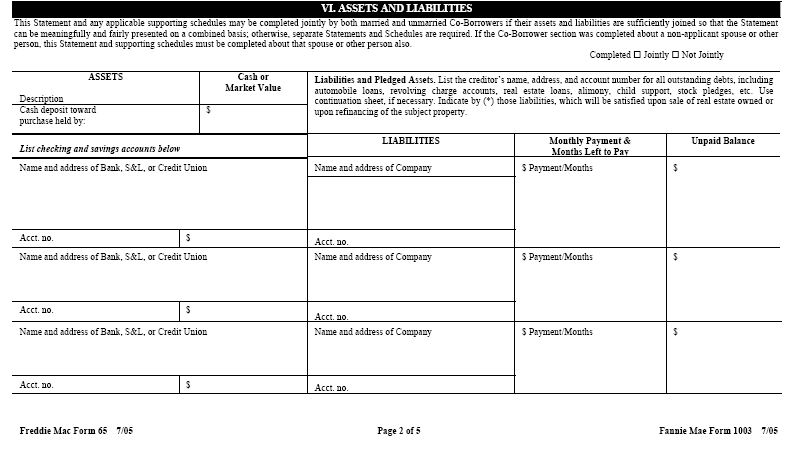
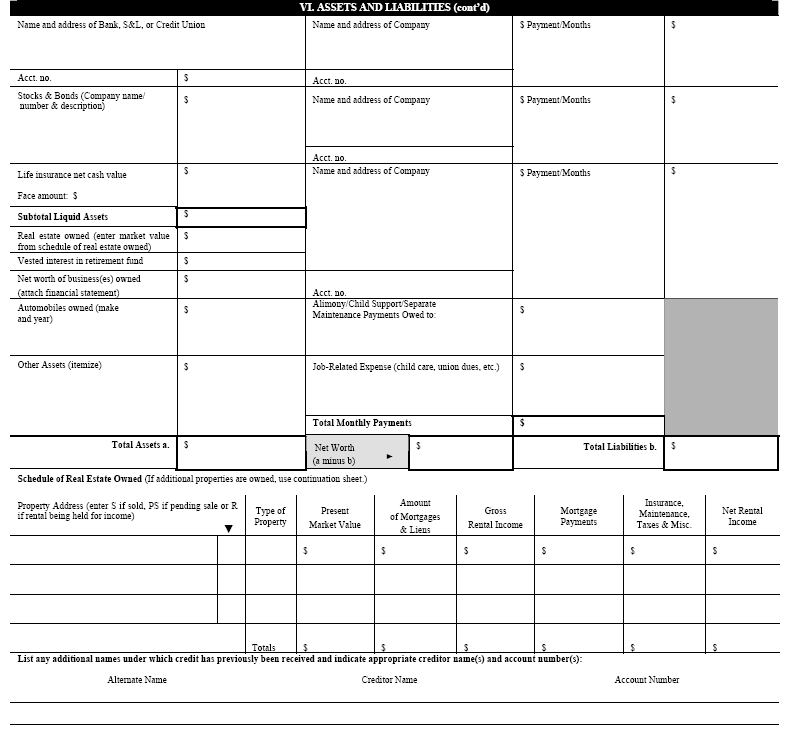
Section VI - Assets and Liabilities
This is how the section looks on paper:
|
|
|